
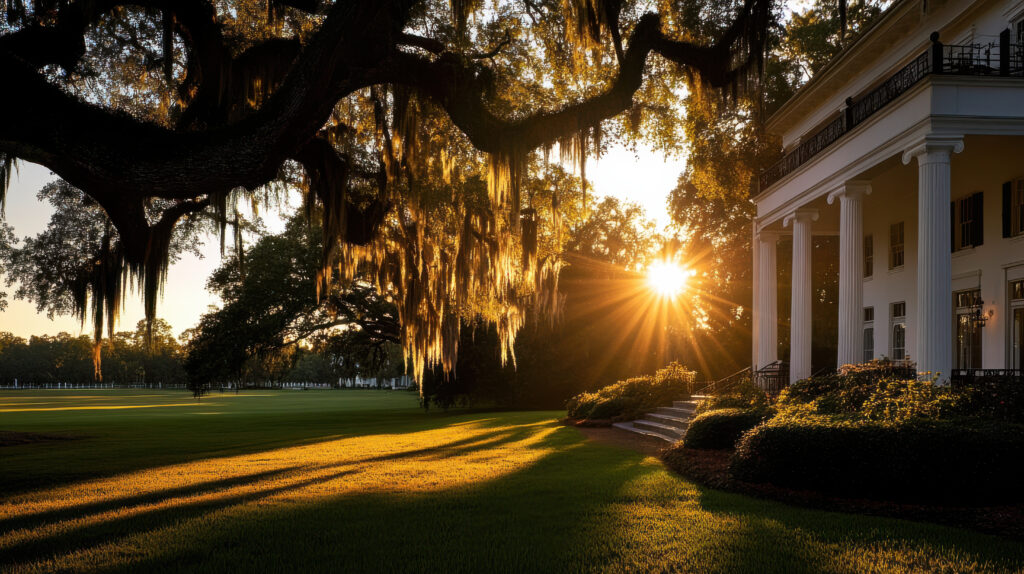
The woman behind the counter at the Natchez Visitors Center looked at me like I had asked a strange question. ‘Why is nobody here?’ I had said, gesturing at the empty streets. It was mid-January, 62 degrees, the azaleas were already threatening to bloom, and I had just walked through three antebellum mansions without encountering another tourist. ‘Honey,’ she said, ‘this is our secret season. Don’t tell anybody.’
The American South in winter is the country’s best-kept travel value. While northern cities layer on parkas and the beach resorts charge peak rates, small Southern towns drop their prices, open their doors, and operate at a pace that feels like what travel used to be before Instagram turned every destination into a content stage.
Natchez, Mississippi: Antebellum Architecture Without the Pilgrimage Crowds
Natchez has more antebellum homes than any city in America, and the reason is grim: the town was too strategically valuable to burn during the Civil War, so Union forces occupied it instead. What remains is a collection of over 1,000 pre-war structures, from grand plantation homes to modest townhouses, lining the bluffs above the Mississippi River.
The Spring and Fall Pilgrimages (home tours) draw most visitors, but winter offers something better: private tours at mansions like Longwood (the largest octagonal house in America, unfinished since 1861 when workers walked off the job to join the Confederate Army) and Stanton Hall (a full city block of Greek Revival grandeur). Winter admission to individual homes is typically $20 to $30 per house. The Natchez Trace Parkway’s southern terminus is here, and the Under-the-Hill district along the riverfront has live blues music most weekends at venues like Smoot’s Grocery and Under-the-Hill Saloon.
Beaufort, South Carolina: The Lowcountry’s Quiet Heart
Beaufort (pronounced BYOO-furt, not like the North Carolina version) sits on Port Royal Island surrounded by saltwater marshes and tidal creeks. Winter temperatures hover in the 50s and 60s, mild enough for kayaking the marsh creeks and biking the quiet residential streets lined with live oaks and Spanish moss.
The historic district has over 170 historic buildings, many dating to the 1700s. Pat Conroy, who set multiple novels here, called Beaufort the most beautiful town in the South. The Conroy Literary Center on Charles Street is a small museum and bookstore. Luther’s Rare and Well Done serves burgers from a former gas station that might be the best casual meal in the Lowcountry. Plum’s restaurant on Bay Street does elevated Southern cuisine with water views. Both are under $25 for lunch.
Eureka Springs, Arkansas: Victorian Charm in the Ozarks
Eureka Springs was built in the 1880s around natural springs believed to have healing properties. The entire downtown is on the National Register of Historic Places: 600 buildings crammed onto steep Ozark hillsides connected by stone staircases and winding streets. No two buildings face the same direction. The effect is less ‘quaint American town’ and more ‘Arkansas version of a European hill village.’
Winter is art season. The galleries along Spring Street stay open year-round, and the Eureka Springs School of the Arts runs workshops through winter in ceramics, painting, and metalwork. Thorncrown Chapel, designed by E. Fay Jones (a Frank Lloyd Wright protege), is a 48-foot-tall glass and wood structure in the woods that is open to visitors for free, typically 9 AM to 5 PM daily. Winter light through the 425 windows is the best light. Crystal Bridges Museum of American Art in Bentonville is an hour’s drive and pairs perfectly.
St. Simons Island, Georgia: Coastal Georgia’s Quiet Season
St. Simons is the most accessible of Georgia’s Golden Isles, connected to the mainland by a causeway (no ferry needed). Winter brings temperatures in the 50s and 60s, empty beaches, and affordable lodging at properties that charge double in summer. The St. Simons Lighthouse Museum ($12 adults) is one of the few operating lighthouses in Georgia, with a 129-step climb to panoramic island views.
Fort Frederica National Monument, established by James Oglethorpe in 1736, is a well-preserved colonial ruin with free admission. The Avenue of the Oaks, a canopy road draped in Spanish moss, is one of the most photographed stretches of road in the South. For food, Southern Soul Barbeque (consistently named one of the best barbecue joints in the South, plates around $12 to $18) stays open year-round. The King and Prince Resort on the beach offers winter rates starting around $150 per night.
Fredericksburg, Virginia: Four Centuries of American History
Fredericksburg sits halfway between Washington, D.C., and Richmond on the Rappahannock River, and its downtown packs more American history per square block than almost anywhere in the country. Four major Civil War battlefields surround the town (all managed by the NPS, free admission). George Washington grew up on a farm across the river. James Monroe practiced law here.
The downtown runs for about 40 blocks along Caroline Street, packed with independent shops, galleries, and restaurants in 18th and 19th century buildings. The winter advantage: these are buildings you can enter and explore without the heat and humidity that makes Virginia summers punishing. Foode restaurant does farm-to-table Southern cuisine ($20 to $35 entrees). The Kenmore Inn, built circa 1793, offers lodging in the historic district. Winter lodging in Fredericksburg runs 30 to 40 percent below spring and summer rates.
Apalachicola, Florida: The Oyster Capital of the Panhandle
Apalachicola is a fishing village of about 2,300 people on Florida’s Forgotten Coast (the Panhandle stretch between Panama City and Tallahassee that tourism largely bypassed). The town has historically supplied 90 percent of Florida’s oysters, though production has declined due to upstream water management disputes with Georgia. The oysters that remain are extraordinary.
Winter temperatures range from the mid-50s to low 70s. The Apalachicola Maritime Museum, the restored Raney House (1838), and the John Gorrie State Museum (honoring the inventor of mechanical refrigeration, who practiced medicine here in the 1840s) are all worth visiting. For dinner, Owl Cafe and Wine Bar does upscale Gulf seafood in a tin-ceilinged dining room. Up the River Inn serves raw and roasted oysters at the source. Both under $30 for a full dinner.
Oxford, Mississippi: Literary History and College Town Energy
William Faulkner’s home, Rowan Oak, sits on 29 acres at the edge of the University of Mississippi campus. It is open for self-guided tours Tuesday through Saturday, free admission. The outline for A Fable is still penciled on the walls of his office. Oxford’s town square, anchored by the Lafayette County Courthouse that Faulkner fictionalized in his novels, is lined with bookstores (Square Books is one of the finest independent bookstores in the South), restaurants, and bars.
Ajax Diner on the square serves meat-and-three lunches ($10 to $14) that embody the best of Mississippi comfort food. Big Bad Breakfast, founded by John Currence (James Beard Award winner), does exactly what the name promises. Winter in Oxford means Ole Miss is in session, the bars and restaurants are full of energy, and the literary heritage is everywhere you look. The Yoknapatawpha Arts Council runs events through winter, and the Oxford Conference for the Book (typically March) draws literary heavyweights.
Bluffton, South Carolina: The Real Lowcountry
Bluffton sits on the May River, about 20 minutes from Hilton Head but operating in a different universe. The Old Town district on Calhoun Street is a single-block stretch of art galleries, studios, and shops housed in structures dating to the 1800s. Thursday evenings bring Art Walks with live music and open studio events.
The Church of the Cross, an 1854 Gothic Revival chapel on a bluff overlooking the May River, is one of the most photographed churches in the South and is open to visitors. Rent a kayak from Bluffton Kayak for a paddle through the tidal creeks ($45 for 2 hours). Captain Woody’s fish tacos on Wharf Street are legendary in the Lowcountry. May River Golf Club, designed by Jack Nicklaus, offers winter rates that drop to about half of peak season.
Frequently Asked Questions
What are the best months for a Southern winter escape?
January and February are the sweet spot. Holiday traffic has cleared, lodging rates hit their annual low, and temperatures across the Deep South average 50 to 65 degrees. March begins the transition to spring with higher prices and more visitors.
How affordable are these Southern winter towns compared to summer?
Expect 25 to 40 percent savings on lodging across the board. Restaurants are generally the same price year-round, but the ability to walk in without reservations at in-demand spots is a significant hidden value. St. Simons and Beaufort see the steepest winter discounts.
Do I need a car for these destinations?
Yes for all eight. These are small towns without meaningful public transit. Natchez, Fredericksburg, Oxford, and Eureka Springs have compact downtowns walkable once you arrive, but you need a car to get there and to explore surrounding areas.